Chatbots vs AI agents: the difference that decides your investment
"We already have AI, we have a chatbot" is the phrase that causes the most confusion in board meetings. A chatbot answers questions; an AI agent executes work. Confusing one for the other is the most common way to misspend an AI budget.
Why this confusion costs you money
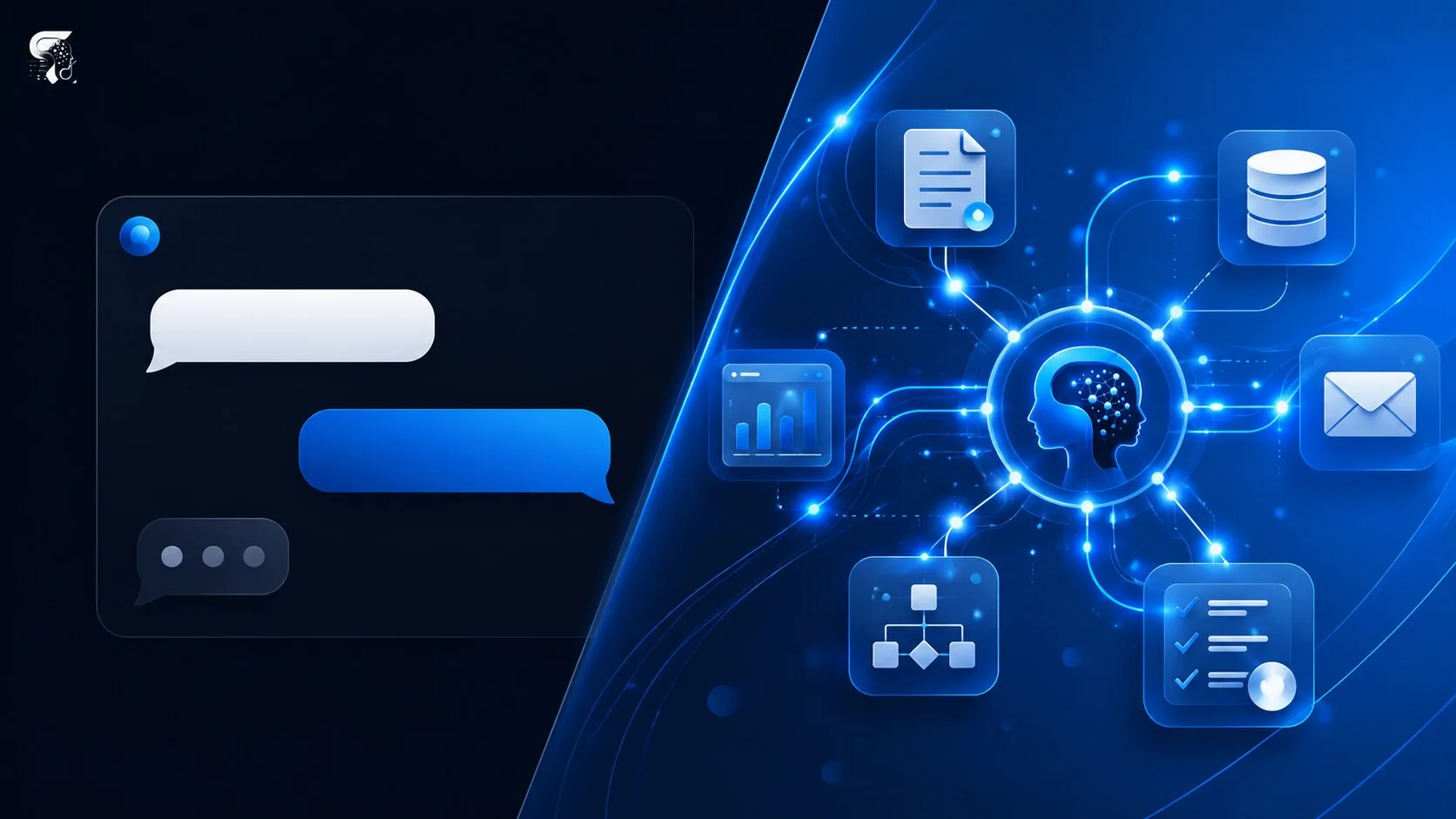
"We already have AI in the company, we set up a chatbot on the website" is one of the phrases I hear most when I start a diagnostic. The problem isn't the phrase itself, it's what it hides: in most cases, that chatbot answers three frequently asked questions with a fixed script or, at best, with a language model that writes nicely but doesn't touch any system. Meanwhile, the team keeps copying data between the CRM, the ERP, and spreadsheets by hand. The company believes it "has AI" when in reality it has a nice conversation layer on top of processes that remain manual. The difference between a chatbot and an AI agent isn't semantic or a marketing distinction: it's the difference between automating a conversation and automating a piece of work. And that difference decides whether your AI investment generates real time savings or just improves the experience of a landing page.
What a chatbot really is (and what it's good for)
- It answers within a closed scope: frequently asked questions, catalog information, hours, return policies, basic order status if connected to a read-only API.
- It doesn't make decisions or execute actions that modify data: it doesn't schedule, cancel, update a record, or trigger a workflow in another system on its own.
- It can be rule-based (a decision tree) or built on a language model that writes better, but in both cases its function is to converse, not to operate.
- It's the right tool when the volume of questions is high, the scope is narrow and predictable, and what you're after is reducing first-response time — not replacing an operational process.
- It's cheap to build and maintain, and that's precisely its value: don't complicate it by asking it to do things it wasn't designed for.
What an AI agent really is (and what sets it apart)
- It can query real systems in real time: your CRM, your ERP, a database, a calendar, an inventory system, with defined permissions and traceability.
- It executes bounded actions within clear rules: creating a ticket, updating a lead's status, generating a quote draft, rescheduling an appointment, escalating a case to a person when appropriate.
- It chains steps: it doesn't just give a single answer, it can reason through several intermediate steps ("if the customer asks for X, first validate Y, then execute Z") before reaching a result.
- It operates with supervision and explicit limits — it isn't uncontrolled AI: sensitive actions (payments, cancellations, sending external communications) are designed with human confirmation or strict business rules, not with total unchecked autonomy.
- It requires real architecture behind it: integrations, role-based permissions, error handling, audit logs — it isn't "a chatbot with a longer prompt."
When a chatbot is enough and when you need an agent
The right question isn't "do we want a chatbot or an agent?" but "what needs to happen after the user sends their message?" If the answer is just "they receive information," a well-designed chatbot is enough and cheaper to maintain. If the answer includes "something needs to change in a system," "an operational decision needs to be made," or "a multi-step process needs to run," you're in AI agent territory. A typical example: a support chatbot that explains how to make a return is fine. An agent that validates the order in the system, checks whether it meets the policy, generates the return label, and notifies the logistics team — that's process automation with AI, and that's where the team's time is really recovered. Most companies don't need to replace their chatbot; they need to clearly decide which part of their operation deserves to move from conversation to execution, and design that layer with the same discipline used to design any critical system.
Signs your current chatbot has fallen short
There are patterns that repeat across the companies that come in asking for a diagnostic. The team keeps getting the same questions via WhatsApp or email because the chatbot isn't connected to what the customer actually needs resolved. Human agents manually copy and paste the bot's answer into another system because the bot can't write there. There's a constant "let's hand the conversation to a person" for tasks that are repetitive and rule-based, not complex human judgment. And perhaps the clearest sign: when you ask the team "how much time does the chatbot save per month?", nobody has a figure, because the chatbot resolves service friction but doesn't remove real operational load. If you recognize two or more of these signs, you don't need a better chatbot — you need to evaluate whether that touchpoint should become an agent with controlled access to your systems.
Frequently asked questions
- Does an AI agent completely replace the people on the team?
- No, and designing it that way is a common mistake. A well-built agent takes on repetitive, high-volume tasks within clear rules, and escalates to a person the cases that require judgment, negotiation, or exceptions. The goal is to free up the team's time for higher-value work, not to remove human oversight from sensitive decisions.
- Is it more expensive to build an agent than a chatbot?
- Yes, because it involves integrations with real systems, defining permissions, error handling, and testing edge cases. That's why it doesn't make sense to build an agent for a use case a chatbot handles just as well. The investment is justified when the automated process frees up time or measurably reduces errors.
- Can I migrate my current chatbot to an agent without starting from scratch?
- In most cases, yes. If the chatbot already has the conversational flow solved, the real work is connecting backend systems, defining which actions it can execute autonomously and which require confirmation, and adding the audit layer. It's not rewriting everything, it's adding the execution layer that's currently missing.
- How do I know if my use case needs an agent instead of an improved chatbot?
- Ask yourself what happens after the bot's response. If a human has to go into a system to do something with that information, that "something" is a candidate for automation with an agent. If the response closes the loop on its own, a well-tuned chatbot is enough.