
Your team loses 40% of the day copying and pasting data: how much it costs and how to eliminate it
Many executives estimate their team spends close to 40% of the workday on repetitive tasks: copying data between systems, answering the same questions, updating spreadsheets. Here's how to calculate the real cost of that time and what replaces it without adding another subscription to the stack.

Repetitive manual work has a measurable cost: hours of your team's time spent copying data between systems, drafting emails that repeat every week, and updating spreadsheets that should already be synced. This article explains how to calculate that cost in your own operation and what replaces it — without adding another software license to a stack no one finishes using well.
The number almost no one calculates
When we ask executives at mid-sized companies how much time their team spends on repetitive tasks, the most common answer hovers around 40% of the operational workday. It's not an official figure from any study — it's what they themselves calculate when they add it up: answering the same questions over WhatsApp, copying a piece of data from one system to another because they're not connected, building a report by hand that could be generated automatically, drafting the same type of email for the umpteenth time. The exact number varies by company. What doesn't vary is that almost no one has added it up — and what isn't measured doesn't get prioritized.
Where that time really goes
- Copying data between systems that don't talk to each other: from the web form to the CRM, from the CRM to the billing spreadsheet, from there to the accounting system.
- Answering questions that already have a standard answer: hours, availability, requirements, base prices — over and over, through the same channel.
- Building manual reports that consolidate information that already exists in some system, just in different formats.
- Drafting repetitive follow-up emails and messages: confirmations, reminders, status updates.
- Fixing errors introduced by the manual process itself: a mistyped data point, a forgotten step, an update that didn't arrive on time.
Why buying another tool doesn't fix this
This is where the most common objection from the executives we work with comes up: "we already tried using AI tools and didn't see real results." And they're right to be skeptical — because software fatigue is real. Companies with half a dozen SaaS licenses that no one uses fully because they aren't integrated with each other or connected to a clear process. Adding one more tool to the pile doesn't eliminate manual work: it just adds one more tab to check. Copy-paste isn't solved with another subscription — it's solved by connecting what you already have with clear rules for what happens automatically and what requires a human decision.
How to calculate the real cost at your company
The exercise is simple and can be done in a spreadsheet this very week: (1) list the repetitive tasks for each operational and commercial role, (2) estimate how many minutes each one takes and how many times it repeats per week, (3) multiply by the number of people who perform it, (4) convert those weekly hours into a value using the loaded hourly cost of each role. The result isn't a generic figure from the internet — it's the real cost of YOUR operation, and it's the number that justifies (or not) prioritizing the automation of that specific process.
What replaces copy-paste
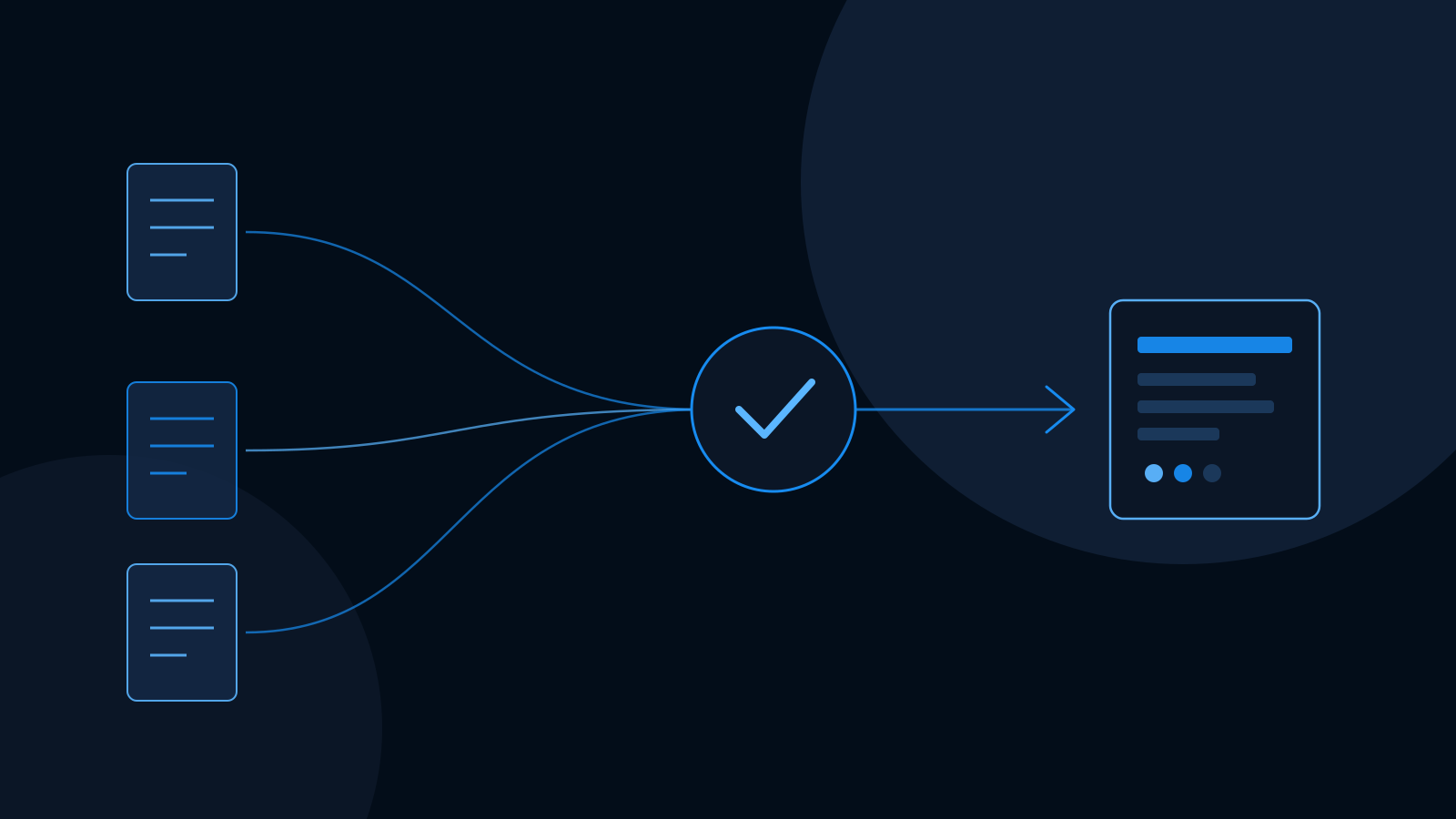
The alternative isn't more software: it's an automation flow that connects the tools you already use — the web form, the CRM, the billing system, WhatsApp Business — through clear rules. When data arrives, it's classified and automatically sent to where it belongs, without anyone copying it by hand. When a question with a standard answer repeats, an assistant answers and only escalates to a person when the case requires it. The decision points that matter — approving a discount, closing a sale, resolving a complaint — remain human; what disappears is the mechanical work of moving information from one place to another.
Frequently asked questions
- Does this mean I no longer need my CRM or billing system?
- No. Automation connects the tools you already have; it's almost never necessary to replace them. The problem usually isn't the tool, but that no one integrated them with clear rules.
- How much does it cost to maintain this month to month?
- It depends on the volume and complexity of the flow, but when using self-hosted automation (like n8n) the recurring cost is usually a fraction of what the manual work hours it replaces would cost — and it's calculated before implementation, not after.
- What happens if the automated flow makes a mistake?
- A well-designed flow includes alerts, retries, and human checkpoints at the decisions that matter. Nothing is automated blindly: it's automated with supervision on what's critical.
- Do I need to know how to code to maintain this?
- No. The system is delivered documented and your team is trained on its day-to-day operation. The goal is for them to depend on the process, not on one person who knows how to code.
The first step isn't to automate, it's to measure
Before automating any process, do the calculation exercise described above. If the number surprises you, you already have the business case to prioritize it. If you want us to do that diagnosis together — mapping your real processes and prioritizing by impact — that's where an AI-First Executive Diagnosis begins, or, if you already know which process you want to automate, an automation architecture built with n8n.
Keep exploring